Qantas has linked New York and Sydney for decades, but never by a regularly scheduled nonstop flight. That will change in 2028, when the airline plans to launch direct service between the two cities under its Project Sunrise program. Qantas first reached New York from Sydney in 1958 as part of its inaugural round-the-world service, routing through Fiji, Honolulu, and San Francisco, while its current Sydney-New York service stops in Auckland. The airline has already tested whether it can make the journey nonstop.
According to Qantas, a Boeing 787-9 flew from New York to Sydney in October 2019 in 19 hours and 16 minutes with 49 people on board as part of a Project Sunrise research flight. Researchers used the flight to study passenger and crew wellbeing, including sleep, meals, lighting, and movement during ultra-long-haul travel. Now, after years of development, Qantas has set a timetable for turning those research flights into regular scheduled service, with Sydney-New York flights due to begin in mid-2028.
Qantas Sets Mid-2028 Launch For Nonstop Sydney-New York Flights
Qantas plans to begin nonstop flights between Sydney and New York in mid-2028, creating the first regularly scheduled nonstop air service connecting Australia with New York. Tickets are scheduled to go on sale in August 2027. The airline expects the journey to take around 18 hours and cut roughly three hours from the fastest current one-stop travel time. The launch and ticket-sale dates remain subject to regulatory approvals and aircraft certification.
New York is the second route confirmed under Project Sunrise, following Sydney-London. Qantas plans to begin daily nonstop flights to London in October 2027, with tickets scheduled to go on sale in February. The airline says the A350 services will cut point-to-point travel times by as much as four hours compared with existing one-stop journeys.
In a statement announcing the New York service, Qantas Group CEO Vanessa Hudson said, “From 2028, our customers will be able to board in Sydney and arrive in New York around 18 hours later without stopping once, cutting around three hours off the current fastest travel time.” The airline also said demand for its New York services has nearly doubled since 2023. According to Qantas research cited by CNBC, intent to book nonstop ultra-long-haul flights rose from 58% to 70% between February and May 2026 and reached 80% among premium travelers.
The Airbus A350-1000ULR Will Make The 18-Hour Route Possible
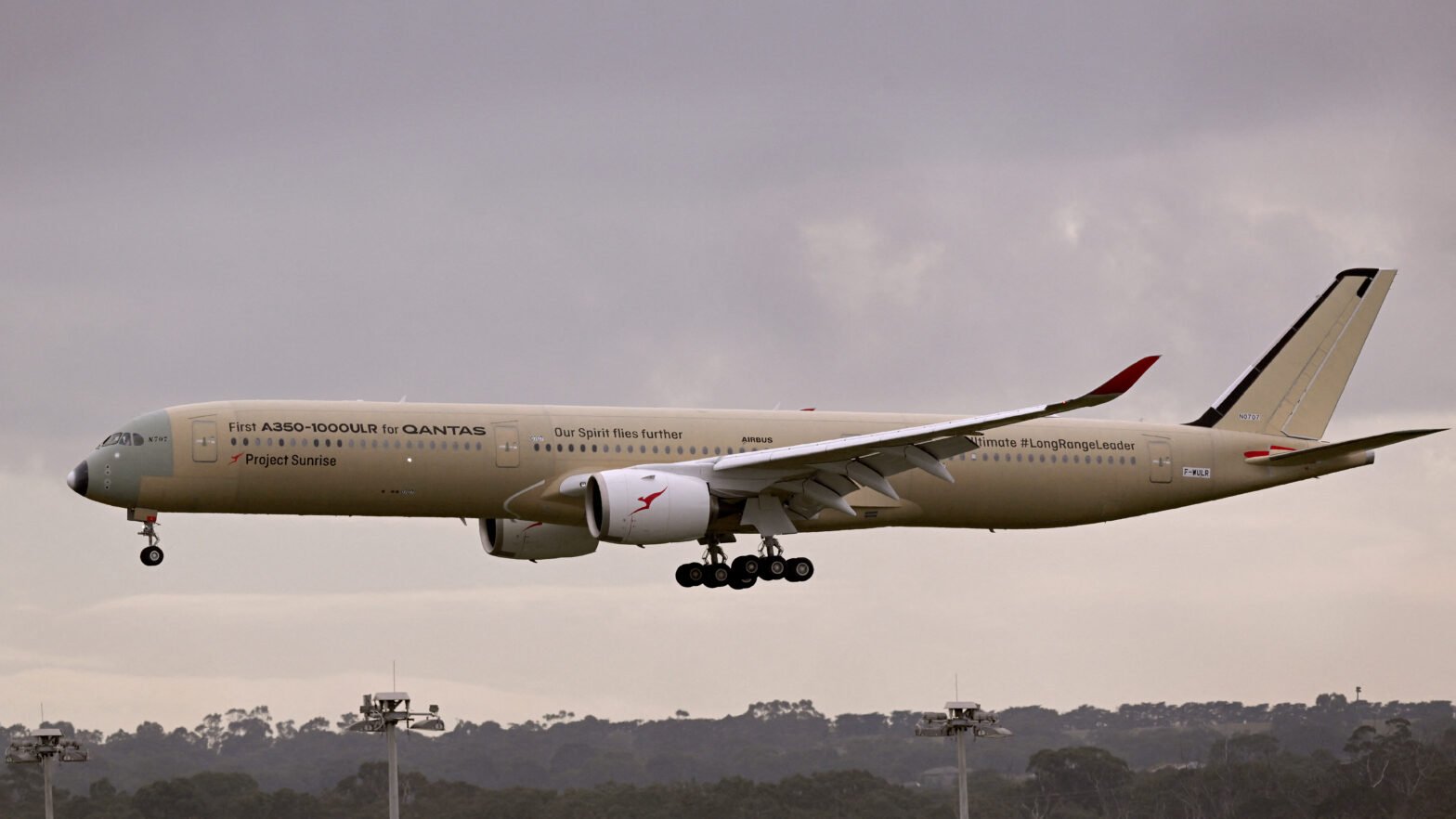
Qantas will operate the New York route with specially configured Airbus A350-1000ULR aircraft developed for Project Sunrise. Airbus has equipped the aircraft with an additional rear center fuel tank holding about 20,900 liters, giving the plane the range required for flights approaching 10,000 nautical miles. Airbus says the aircraft is being developed for flight times of up to 22 hours.
Qantas has ordered 12 A350-1000ULRs. Each aircraft will carry 238 passengers, with six first-class suites, 52 business-class suites, 40 premium economy seats, and 140 economy seats. The economy cabin includes 42 Qantas Economy Plus seats with a 34-inch pitch, priority boarding, and priority access to overhead storage. More than 40% of the aircraft’s seats will sit in premium cabins.
The aircraft will also include a Wellbeing Zone between premium economy and economy. Qantas says the area will feature integrated stretch handles, guided movement programs, a hydration station, and refreshments. The airline worked with researchers from the University of Sydney’s Charles Perkins Centre on cabin features intended to address sleep, movement, lighting, and other effects of ultra-long-haul flying.
Airbus began flight testing the A350-1000ULR in June 2026. In July, a test aircraft completed a 24-hour, 24-minute nonstop development flight from Melbourne to Toulouse, covering 12,460 nautical miles while Airbus evaluated systems including fuel management and cabin conditions. Qantas expects its first Project Sunrise aircraft, named Vega, to arrive in April 2027, ahead of the Sydney-London launch later that year and the New York service in 2028.